
Industrial Sourcing Insights
Supplier Consolidation vs. Multi-Sourcing: How Procurement Teams Should Choose
Compare supplier consolidation and multi-sourcing by procurement workload, supply risk, specification consistency, spend visibility, and business continuity.
August 23, 2026
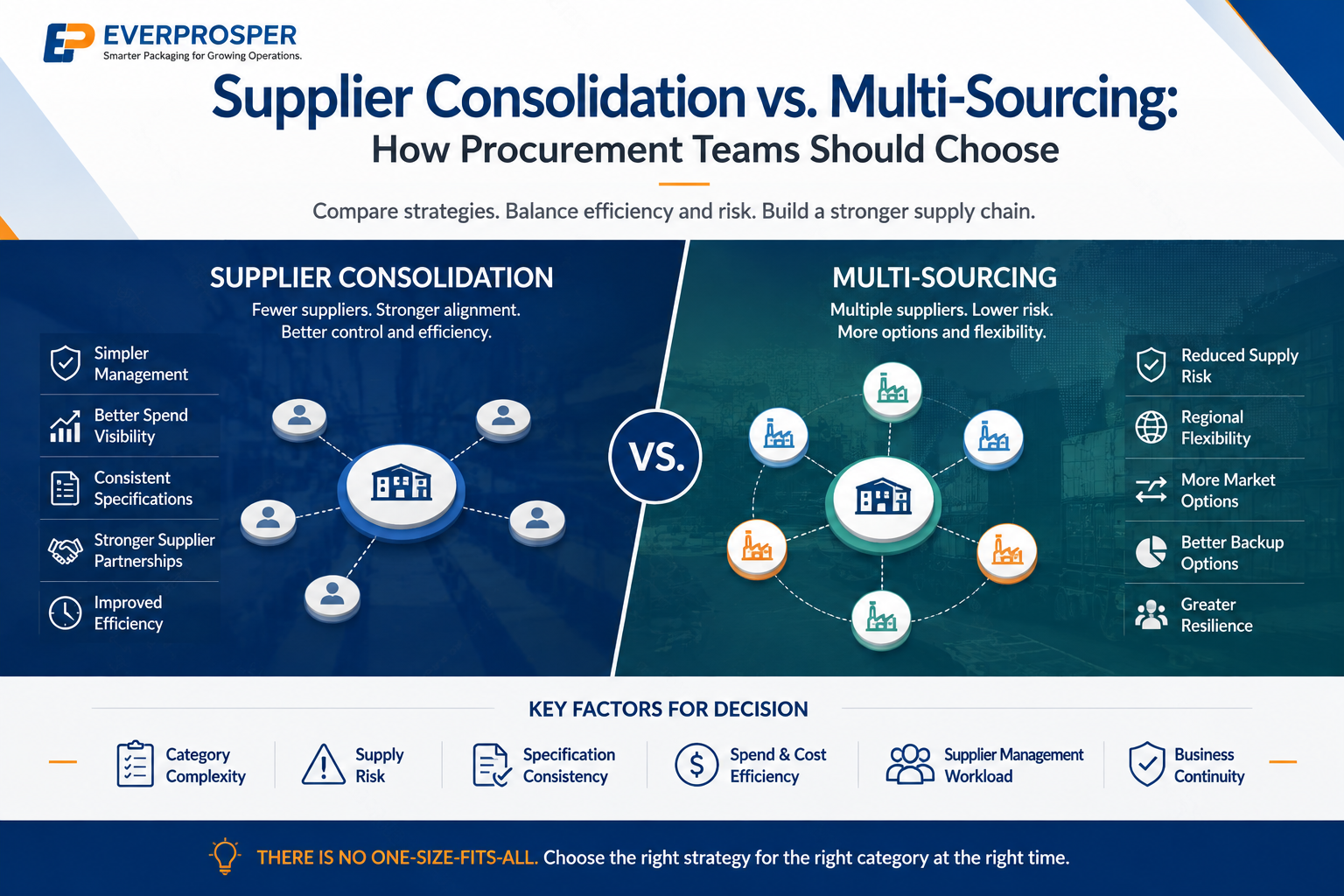
A procurement strategy guide for comparing supplier consolidation and multi-sourcing by workload, supply risk, specification consistency, spend visibility, and continuity needs.
Summary: Supplier consolidation and multi-sourcing are both valid procurement strategies. The right choice depends on category complexity, supply risk, specification consistency, supplier management workload, spend fragmentation, and the maturity of the purchasing organization.
This article explains how procurement and supply chain teams can compare consolidation and multi-sourcing without treating either model as a universal answer.
What Supplier Consolidation Means
Supplier consolidation means reducing the number of suppliers used for a category, region, product group, or purchasing workflow. The goal is usually to improve control, simplify communication, reduce duplicated supplier management work, and concentrate spend with selected partners.
Consolidation does not always mean using only one supplier. In many industrial categories, it may mean moving from a long, fragmented supplier list to a smaller group of qualified suppliers that can support consistent specifications, clearer pricing review, and more manageable purchasing processes.
- Fewer supplier relationships to manage
- More consistent specifications and documentation
- Better spend visibility by category
- Simpler communication for repeat purchasing
- Potentially stronger supplier accountability
What Multi-Sourcing Means
Multi-sourcing means using more than one supplier for the same product, category, or business requirement. It is often used to reduce dependency on a single supplier, protect supply continuity, compare market options, and manage risk across regions or production sources.
Multi-sourcing is not the same as uncontrolled supplier sprawl. A strong multi-sourcing strategy still requires supplier qualification and evaluation, specification alignment, supplier performance review, and clear purchasing rules.
- Reduced dependency on one supplier
- Backup options for supply interruptions
- Market comparison across suppliers
- Flexibility for changing demand or product requirements
- Potential resilience across regions or production sources
Supplier Consolidation vs. Multi-Sourcing
| Decision Factor | Supplier Consolidation | Multi-Sourcing |
|---|---|---|
| Procurement workload | Can reduce daily supplier management work | Requires more coordination and performance tracking |
| Supply risk | Can increase dependency if backup sources are weak | Can reduce dependency when suppliers are qualified |
| Specification consistency | Often easier to control with fewer suppliers | Requires stronger specification alignment across suppliers |
| Spend visibility | Usually easier to analyze by category | Can become fragmented without clear purchasing rules |
| Category complexity | Works well for repeatable, standardized categories | Useful for complex categories with supply or regional variation |
| Business continuity | Needs backup planning | Can improve continuity when alternates are ready |
When Consolidation Can Improve Efficiency
Supplier consolidation can be useful when a purchasing team is spending too much time managing small orders, duplicate suppliers, inconsistent pricing, repeated RFQs, and fragmented communication. For related cost-control context, review how procurement teams can reduce procurement costs without increasing supply risk. This often happens when different departments source similar industrial supplies from separate vendors without a shared category strategy.
Consolidation may help when the category is stable, specifications are repeatable, and the business needs better purchasing control. Examples may include recurring industrial consumables, warehouse supplies, packaging materials, and standard operating supplies where the buyer can define specifications clearly.
Common consolidation signals
- Too many suppliers for similar items
- Inconsistent product descriptions or specifications
- Repeated small RFQs for repeat purchases
- Difficulty comparing pricing across suppliers
- High administrative workload for purchasing teams
- No clear owner for supplier performance review
When Multi-Sourcing Can Reduce Risk
Multi-sourcing can be more appropriate when the cost of supply interruption is high, product specifications are sensitive, demand changes quickly, or one supplier cannot reliably support all business needs. It can also help when buyers need regional flexibility or want to avoid overdependence on one production source.
The value of multi-sourcing depends on discipline. Adding suppliers without qualification can create confusion, inconsistent quality, and hidden costs. The goal is not simply to have more suppliers; it is to have qualified alternatives that can support the same purchasing requirements.
Common multi-sourcing signals
- Single-source dependency creates supply continuity risk
- Demand changes faster than one supplier can support
- Different applications require different specifications
- Regional supply or logistics risks affect delivery
- Procurement needs market comparison before committing volume
A Practical Decision Framework
Procurement teams can use a structured review before deciding whether to consolidate suppliers, add qualified alternates, or use a hybrid model.
- Map category spend. Identify supplier count, annual spend, order frequency, and duplicate purchases.
- Review business risk. Estimate the operational impact if the current supplier cannot deliver.
- Separate standard and strategic items. Standard repeat purchases may support consolidation, while risk-sensitive items may need qualified alternatives.
- Define specification control. Confirm whether different suppliers can meet the same product requirements.
- Assess supplier workload. Count how much time purchasing, quality, operations, and finance spend managing the supplier base.
- Build a backup plan. Even consolidated categories may need alternate sourcing paths for continuity.
Why the Right Answer Changes by Business Stage
A growing company may benefit from supplier consolidation because early purchasing often becomes fragmented. As order volume increases, the business may need clearer supplier ownership, standardized specifications, and better spend visibility.
A mature operation may need selective multi-sourcing because higher volume can create continuity risk if one supplier becomes constrained. For that reason, many procurement teams use a hybrid strategy: consolidate routine purchasing where possible, but maintain qualified alternates for critical categories.
How This Applies to Industrial Products
Industrial purchasing often involves products that look simple but depend heavily on application details. Packaging materials, ESD supplies, security seals, warehouse consumables, and sourced equipment can vary by specification, usage environment, and documentation requirements.
For example, a buyer may consolidate repeat packaging purchases to reduce workload, while maintaining alternate suppliers for risk-sensitive or specification-sensitive items. Another buyer may multi-source a category during supplier qualification, then consolidate after performance becomes predictable.
How to Keep the Strategy Practical
A sourcing strategy should be documented in a way that purchasing teams can actually use. That means defining which categories should be consolidated, which categories need backup suppliers, who approves supplier changes, and how specification differences will be reviewed before orders are placed.
The strategy should also be revisited when volume changes, a new product category is added, a supplier performance issue appears, or business continuity requirements become more important. A strategy that worked for a small purchasing team may need adjustment as the operation becomes more complex.
Buyer Checklist
- Which categories have too many suppliers for similar items?
- Which categories would create major disruption if one supplier failed?
- Are specifications clear enough for supplier comparison?
- Can supplier performance be measured consistently?
- Would consolidation improve control, or would it create dependency risk?
- Does the business need a primary supplier plus qualified backup options?
FAQ
Is supplier consolidation the same as single sourcing?
No. Consolidation reduces supplier count, but it does not always mean relying on one supplier. Many teams consolidate to a smaller group of qualified suppliers.
When is multi-sourcing useful?
Multi-sourcing is useful when supply continuity, regional flexibility, demand changes, or specification risk make dependency on one supplier too risky.
Can a company use both strategies?
Yes. Many procurement teams consolidate standard purchases while keeping qualified alternate sources for critical or high-risk categories.
What should be reviewed before changing supplier strategy?
Review spend fragmentation, order frequency, category complexity, supplier performance, specification consistency, continuity risk, and internal workload.
Request Sourcing Support
If your team is reviewing supplier consolidation, multi-sourcing, or category sourcing strategy, Everprosper can support supplier comparison, specification review, and RFQ preparation for industrial purchasing categories.